If you are drawn to privacy, controlled access, and a more polished arrival experience, Scottsdale guard-gated communities can be very appealing. But not every gate works the same way, and not every community offers the same lifestyle, costs, or rules. If you are thinking about buying in one of these neighborhoods, this guide will help you understand how guard-gated living works in Scottsdale and what to ask before you decide. Let’s dive in.
What guard-gated means in Scottsdale
In Scottsdale, most guard-gated communities are planned communities with a homeowners association, or HOA. Under Arizona law, that usually means owners are mandatory members of the association and pay assessments that help support shared obligations like common property or roadway-related responsibilities.
That matters because the gate is only one part of the ownership experience. When you buy in a guard-gated community, you are also buying into a structure that includes community documents, rules, budgets, and ongoing assessments.
Where these communities are most common
Many of Scottsdale’s guard-gated communities are concentrated in North Scottsdale. The city’s planning approach emphasizes character, open space, and protection of desert and mountain lands, which helps explain why so many of these neighborhoods are tied to preserve settings, golf environments, and lower-density desert development.
That said, Scottsdale is not one-size-fits-all. The city’s Dynamite Foothills Character Area Plan specifically discourages gated communities in that area, which shows that the local approach can vary by submarket.
How gate access usually works
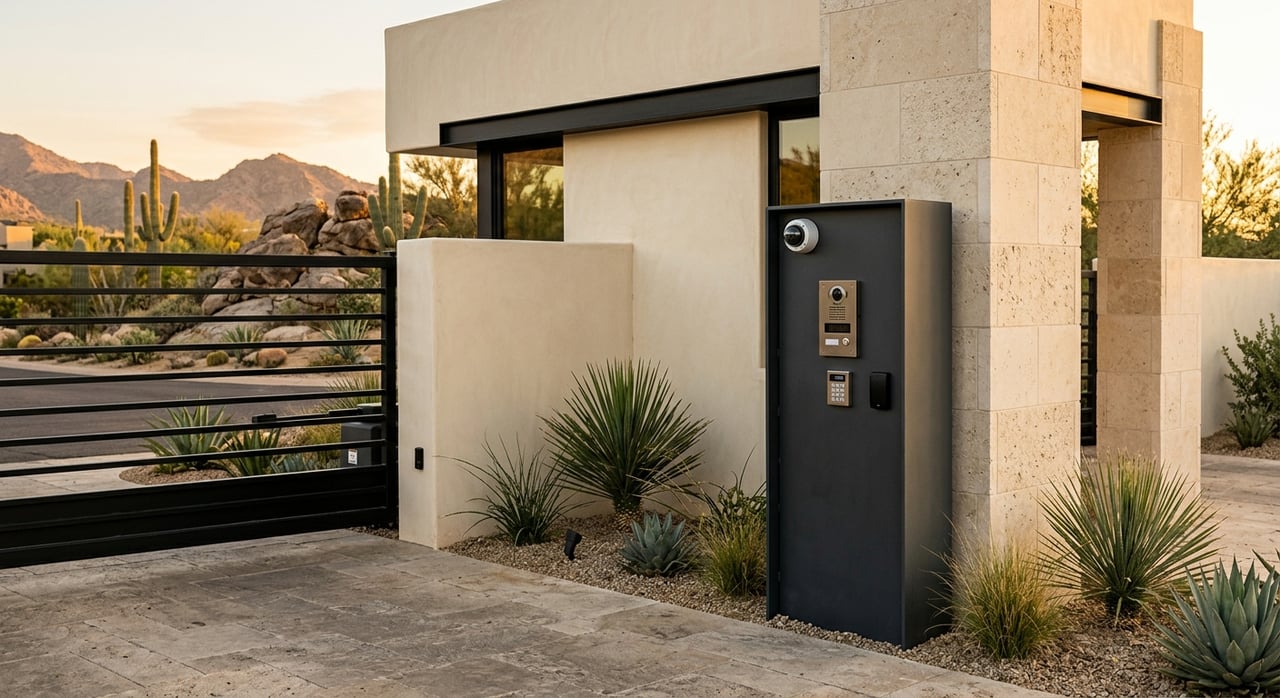
A guard-gated entrance typically provides private access control, not city-operated security. In practical terms, that often means gate staff, resident entry systems, visitor management tools, and sometimes community patrol services.
The details can vary a lot from one neighborhood to the next. In DC Ranch, for example, the community reports 24-hour patrol through a third-party contractor, 23 gates, live video feeds, and several gatehouse and patrol contact points. Residents can add guests through the gatehouse, an online platform, or an app, and some arrivals may need verbal validation codes or photo ID.
Stonegate uses a different model. Its main gate is manned 24/7, it has three resident-only gates, and guest or vendor access is handled through QuickPass software with specific vendor-hour limits.
Desert Mountain reflects more of a club-community setup. It reports around-the-clock gate access management, patrols, traffic enforcement, wildlife management, health emergency response, and eGo tags for up to five vehicles per owner, renewed every two years.
What a gate does and does not do
A gate can help reduce casual traffic and make guest access more controlled. For many buyers, that added layer of privacy and structure is a major benefit, especially if you travel often or want a more managed entry experience.
Still, it is important to keep expectations realistic. Some Scottsdale communities state clearly that their gates are for access control only, not security purposes, and DC Ranch directs residents to call Scottsdale Police for suspicious activity or crime concerns.
The key takeaway is simple: a gate is helpful, but it is not a substitute for home-level planning. If privacy and peace of mind matter to you, it makes sense to think about alarms, cameras, lighting, and how your own home is positioned within the community.
HOA rules and documents to expect
Because guard-gated communities usually operate through an HOA, buyers should expect a fairly detailed document review. Arizona law defines community documents to include the declaration, bylaws, articles, and rules, and planned-community meetings are generally required to be conducted openly with notice and agendas.
Arizona’s resale-disclosure requirements are especially important when you are under contract. Buyers are entitled to receive documents such as the bylaws, declaration, assessments, budget, annual financial report, reserve study if there is one, and a litigation summary.
There can also be transfer-related document fees. Under Arizona law, the association may charge up to $400 for resale disclosure and related transfer documents, with limited additional fees for rush processing or updates.
Costs go beyond monthly dues
One of the biggest misconceptions about guard-gated living is that you are only comparing one HOA payment to another. In reality, your carrying costs may reflect a much broader set of services and infrastructure.
Communities with staffed gates, patrols, private roads, clubhouses, pools, golf environments, and large landscaped common areas often have higher operating costs than non-gated neighborhoods. That does not automatically make them a poor value, but it does mean you should look closely at what your assessments actually cover.
Water use can be part of that picture too. Scottsdale Water notes that HOA common-area landscapes are often high water users and may require irrigation improvements, desert-friendly planting, leak monitoring, and ongoing efficiency work.
Amenities can vary widely
One of the most important things to know is that Scottsdale guard-gated communities are not all the same product. Some are packed with amenities and social programming, while others lean more toward privacy, custom homes, and desert preservation.
Bellasera is one example of an amenity-rich North Scottsdale community. It describes a 5,000-square-foot clubhouse, fitness center, pool and spa, tennis, pickleball, basketball, a dog park, and about eight miles of multi-use paths.
Stonegate also offers a strong amenity package, including a community center, junior-sized Olympic pool, waterfall spa, ramada, seven tennis courts, two pickleball courts, a half basketball court, and nearly 100 acres of open space.
At the luxury club end, Desert Mountain reports 8,300 acres, seven clubhouses, 10 restaurants and grills, a 42,000-square-foot Sonoran Clubhouse, nine tennis courts, eight pickleball courts, 25 miles of private hiking trails, and more than 40 social clubs. It also notes that the housing mix ranges from lock-and-leave condominiums to mountainside estates.
Sincuidados offers a different feel. It describes more than 300 custom homes, a living desert landscape, community ownership of Lone Mountain and an 80-acre preserve, 4.5 miles of hiking trails, a clubhouse, and court amenities.
Full-time living or lock-and-leave
For many buyers, the lifestyle fit matters just as much as the home itself. Some guard-gated communities are especially appealing if you want a lock-and-leave option for seasonal use or frequent travel.
Others may feel better suited to full-time living, especially if you want larger lots, custom-home character, preserve views, or a quieter setting. The right choice often comes down to how much you value social amenities, ease of arrival, maintenance structure, and the level of HOA oversight you are comfortable with.
Questions to ask before you buy
Before you choose a guard-gated community in Scottsdale, it helps to ask very specific questions. Small operational differences can have a big impact on your day-to-day experience.
Here are a few smart questions to bring up:
- Is the gate manned 24/7, staffed only at certain times, or mainly app and code based?
- Are there resident-only gates, and how fast is resident access during busy hours?
- How are guests, contractors, deliveries, and rideshare drivers admitted?
- Are there set vendor hours that could affect service appointments?
- What do the HOA dues cover, and are club dues separate?
- Are there rules for rentals, parking, architecture, or exterior changes?
- How much of the budget goes toward gate operations, roads, landscaping, reserves, or amenities?
- Does the community feel more social and club-oriented, or more private and low-key?
These questions can help you compare communities on more than appearance alone. They also help you avoid surprises after closing.
Why local guidance matters
On paper, many guard-gated communities can sound similar. In person, they often feel very different based on access systems, amenity depth, lot layout, home style, and the overall pace of life.
That is where local insight becomes valuable. If you are weighing options in North Scottsdale or comparing privacy-focused enclaves with club-style communities, it helps to have someone who can guide you through both the property and the lifestyle tradeoffs.
Scottsdale guard-gated communities can be a great fit if you want controlled access, desert surroundings, and a more tailored ownership experience. If you want help narrowing down the right community for your goals, connect with The Hoods Real Estate Team for thoughtful, concierge-style guidance in Scottsdale.
FAQs
What is a guard-gated community in Scottsdale?
- A Scottsdale guard-gated community is typically a planned community with mandatory HOA membership, recorded governing documents, and shared assessments, plus a controlled entrance system managed by the community rather than the city.
Are Scottsdale guard-gated communities the same as secure communities?
- Not exactly. Many provide controlled access and visitor management, but some communities state clearly that gates are for access control only and not a guarantee of security.
What HOA documents should buyers review in Scottsdale guard-gated communities?
- Buyers should expect to review the declaration, bylaws, rules, assessments, budget, annual financial report, reserve study if available, and a litigation summary as part of Arizona’s resale-disclosure process.
Do Scottsdale guard-gated communities usually have higher fees?
- They can, especially when dues help cover staffed gates, patrols, private roads, amenities, landscaping, and other shared community costs.
Are Scottsdale guard-gated communities good for lock-and-leave buyers?
- Many can be, especially communities with managed access and low-maintenance housing options, but the best fit depends on the specific rules, services, and housing style in each neighborhood.
What should buyers ask about guest access in Scottsdale guard-gated communities?
- You should ask how guests, vendors, deliveries, and rideshare drivers are admitted, whether apps or gate staff are involved, and whether there are restricted vendor hours or resident-only gates.